
Category: UX advice / Ecommerce guides
I released a new edition of my Amazon-bestselling book Designing Ecommerce Websites in July 2024, now with 72 guidelines and insights for creating great online stores. This is an adapted version of the book’s introduction to explain why it exists and who can benefit from it…
There’s no denying that ecommerce is now massive. The use of online shopping has been steadily increasing for years and when most of the world went through lockdowns during the 2020-21 Covid pandemic there was an extra leap forward. The UK (who collect good data on this) shows this growth with online sales in 2023 accounting for 26.6% of all retail, where it was 10.4% just 10 years before.
The trend is similar everywhere and it is clear: as new generations become shoppers they’ll expect to be able to buy everything online, from nuts and bolts to cars. This creates a challenge. If you’re involved in running or designing an ecommerce website it’s getting ever more competitive to turn your users into your customers.
You could do this by slashing prices, pestering users with new promotions, and pouring more money into your digital marketing, which comes at a cost. Or you could make sure your website is doing everything possible to provide a smooth and seamless website experience where users can easily convert. Average conversion rates are between 1-6% depending on industry, so it’s not like there isn’t still plenty of room for improvement.
One ecommerce site that I worked on a few years ago illustrates how good design is about more than polished graphics. Like most of my consulting projects, I first set up user testing to see what users thought of the site. Their products were great and the visual design and imagery were beautiful. Users were immediately impressed and said how excited they were.
However the search filters were fiddly, the product pages weren’t clearly laid out, and when it came to making a purchase, users got completely stuck. They weren’t sure how products were priced or how to select different options. If they did work this out it then wasn’t clear how to make a change, so they’d have to start all over again. The initial great impression had totally worn off.
It doesn’t matter if you have the best-looking products in the world, with sharp type and colour combinations, if users are tripping up on the essential functions then they’ll quickly get annoyed and leave. Many times I’ve seen user experience (or UX) most defined by the frustration of things not working as people expect. Of course there’s room to innovate and delight but doing so without the core functions performing only makes things worse.
With mobile users forming the majority of ecommerce traffic on every store now, you have to think mobile-first and I’m pleased to say this book does. Unfortunately so many articles and guides still treat smaller screens as an afterthought. The advice here is device-agnostic and every guideline (bar a couple, which are flagged) applies to desktop, tablet, and mobile, with the illustrations based on the smaller mobile screen sizes.
If your ecommerce store is a vehicle then this book is here to help you get the engine running smoothly before you move onto the paint job.
I’ve written this book with small businesses in mind—whether you own a bricks and mortar store or you’re more of an entrepreneurial side-hustler. If you want to improve how your ecommerce site performs, regardless of the sector, this will give you plenty of ideas.
It should also be helpful for marketers, developers, and graphic designers who are thinking about the user experience. I’ve tried to avoid any UX jargon and technical knowledge and explain the few terms I do use as I they come up.
I’m experienced in this area, working as a UX designer for over 14 years, with more than a decade in the ecommerce space. I’ve consulted to a range of companies selling a variety of products, and before that spent three and a half years at a fast-growth travel startup (onefinestay). I’ve learned the advice here over the course of my career and they are the principles I applied when hired as a UX consultant.
I taught on the subject of ecommerce UX design between 2013-2018. I initially developed the advice in this book through teaching regular workshops at General Assembly in London where I refined it to be robust and applicable to a wide variety of people. During this time I also wrote weekly blogs on UX design, including popular articles on the likes of UX Planet and the InVision blog.
To top it off, I’ve taken everything I’ve learned and have gone to ‘the other side’ and applied it. Since 2019 I’ve been running my own ecommerce sites, selling poster art that I design. In recent years it has grown to become a full time job.
So I’ve designed ecommerce sites; I’ve researched many big ecommerce sites; I’ve looked at a lot of analytics; I’ve analysed many user tests; I’ve built and grown my own online store; and of course I’ve shopped on plenty myself.
Even though I have experience, I think you should be wary of people offering ‘best practice’, as there will always be cases where it can be challenged. This is why I refer to this content as guidelines rather than hard and fast rules, but where possible I explain the data or experience that has lead to my conclusions.
The chapters in this book are organised to mirror the structure of the vast majority of ecommerce websites. This structure consists of types of page that exist not just due to convention: they exist because there are jobs that a user needs to do on every website. It’s known as a funnel because there are always more people entering at the top, tapering off to the few that purchase at the bottom.

I’ve written in more detail about the role of each of the steps in a series of articles on the ecommerce experience funnel, which starts here.
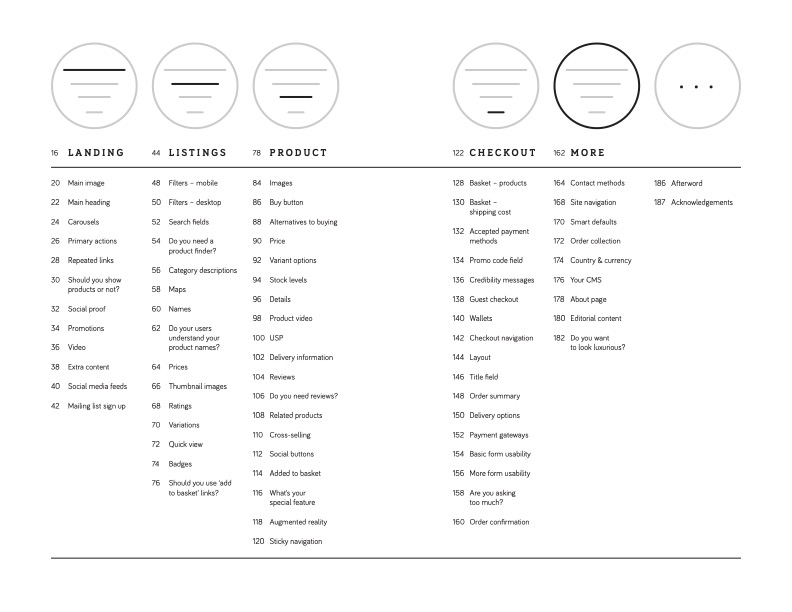
This book is designed so that you can easily find what you need, with a guideline per webpage element. Some of the guidelines are framed as questions and they pose things to think about that may not apply to all sites. Overall this book doesn’t aim to be a theoretical tome but a reference handbook that is easy to pick up, use, and come back to, so it can answer your challenges as they arise.
Within the chapters each guideline is presented on a double-page spread, and most of them come with an illustration to help clarify the meaning. These illustrations are done in the style of wireframes, a classic UX design format for demonstrating a concept without any extraneous detail.
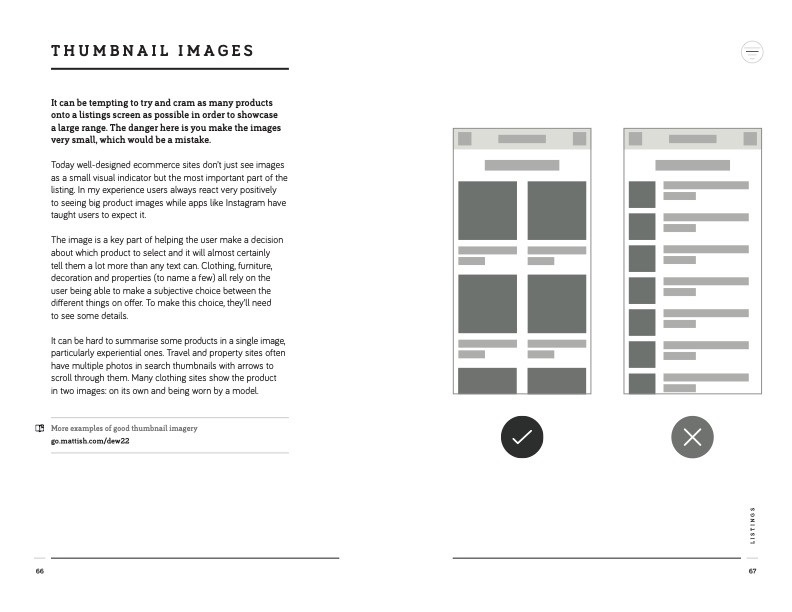
The thing about good UX design advice is it really isn’t rocket science. In fact when explained it sounds like common sense. Yet it’s amazing how often I still see sites that don’t do even these apparently obvious things. I hope you’re already following some of the guidelines here but chances are there are some that will be new.
The first edition of this book in 2017 was something of a ‘beta’ release to get it out there and test the waters, while the second in 2019 was polished and complete. For a self-published book, the second edition sold well and picked up a lot of positive reviews, so for the third edition I’ve kept everything that worked about it whilst iterating to bring it up to date.
A few years ago I didn’t think I would come back to do a third edition, but having spent most of the intervening period running my own online store I thought I had a new perspective I could bring to make the advice relevant for more people. Not to mention that web technology is always moving forward and things get dated, so there are always tweaks that can be made.
There are four main ways the book has been improved:
I hope the book will be useful as a comprehensive beginner’s guide to ecommerce UX design and improving your website or those you work on. Please see it as a starting point and build on the advice as you test things out with your websites and users. Here’s to higher sales!
The full book is available in digital form from this site, and in print from Amazon, see the buying options here.
Designing Ecommerce Websites is the Amazon-bestselling book that will tell you how to upgrade the user experience of your online store. Built on 15+ years of experience, it tells you what works in practice, not just in theory.
– rated 4.5 on Amazon US and UK


